MyDBA.dev vs Percona PMM: Deep PostgreSQL Intelligence vs Multi-Database Monitoring
MyDBA.dev vs Percona PMM: Deep PostgreSQL Intelligence vs Multi-Database Monitoring
Percona Monitoring and Management (PMM) is one of the most established open-source database monitoring tools available. It is free, actively maintained, and supports MySQL, MongoDB, and PostgreSQL. If you run a polyglot database environment and want a single pane of glass, PMM is a strong option. This article compares PMM with MyDBA.dev to help you decide which tool fits your PostgreSQL monitoring needs.
The Quick Summary
| Capability | Percona PMM | MyDBA.dev | |---|---|---| | Pricing | Free (open source, self-hosted) | Free: one primary or standalone, no replicas; Pro: £50/primary + £25/replica/month (GBP) | | Database support | MySQL, MongoDB, PostgreSQL | PostgreSQL only | | Deployment | Self-hosted (Docker/VM) + agents on every host | SaaS -- lightweight collector, no server to manage | | Query analytics | QAN with fingerprinting, EXPLAIN plans | Query monitoring with fingerprinting, EXPLAIN + EXPLAIN ANALYZE, plan regression detection | | Health checks | Percona Advisors (security, config, performance) | 75+ health checks with scored domains and fix scripts | | Index advisor | No | Yes -- missing index detection with CREATE INDEX statements | | XID wraparound | Basic metric exposure | Dedicated monitoring with blocker detection and recovery scripts | | Extension monitoring | No | TimescaleDB, pgvector, PostGIS | | Alerting | Built-in (Alertmanager integration) | Built-in with digest notifications | | Lock visualization | Standard lock metrics | Interactive lock chain dependency graphs | | Schema comparison | No | Yes -- cross-instance schema diff | | Backup integration | Yes (Percona Backup for MongoDB, xtrabackup) | No | | Dashboards | Grafana (customizable) | Purpose-built UI |
Where PMM Excels
PMM deserves credit for what it does well, and it does several things very well.
It is genuinely free. Not freemium, not open-core with paywalled features -- fully free and open source. As of 2026, all Percona Advisors (security, configuration, and performance checks) are available without any subscription. For teams with limited budgets, this matters.
Multi-database support is first-class. If you run MySQL, MongoDB, and PostgreSQL in the same environment, PMM gives you a single monitoring platform for all three. The MySQL and MongoDB coverage in particular is excellent -- PMM was born from Percona's deep MySQL expertise, and it shows. Query Analytics (QAN) provides fingerprinted query analysis with execution statistics and EXPLAIN plans across all supported databases.
Grafana dashboards are flexible. PMM ships with dozens of pre-built Grafana dashboards and you can create your own. If your team already knows Grafana, the learning curve is minimal. You can correlate database metrics with infrastructure metrics in custom dashboards.
Percona Advisors provide automated checks. The advisor framework runs security checks (default passwords, SSL configuration), configuration checks (memory settings, checkpoint tuning), and performance checks (table statistics, replication lag). These run automatically and surface findings in the UI.
Backup and restore integration. PMM integrates with Percona's backup tools -- xtrabackup for MySQL and Percona Backup for MongoDB. If backup monitoring is part of your workflow, PMM handles it natively.
Where MyDBA.dev Goes Further
The core difference is specialization. PMM is a multi-database monitoring platform adapted to support PostgreSQL. MyDBA.dev is built exclusively for PostgreSQL.
75+ Health Checks with Fix Scripts
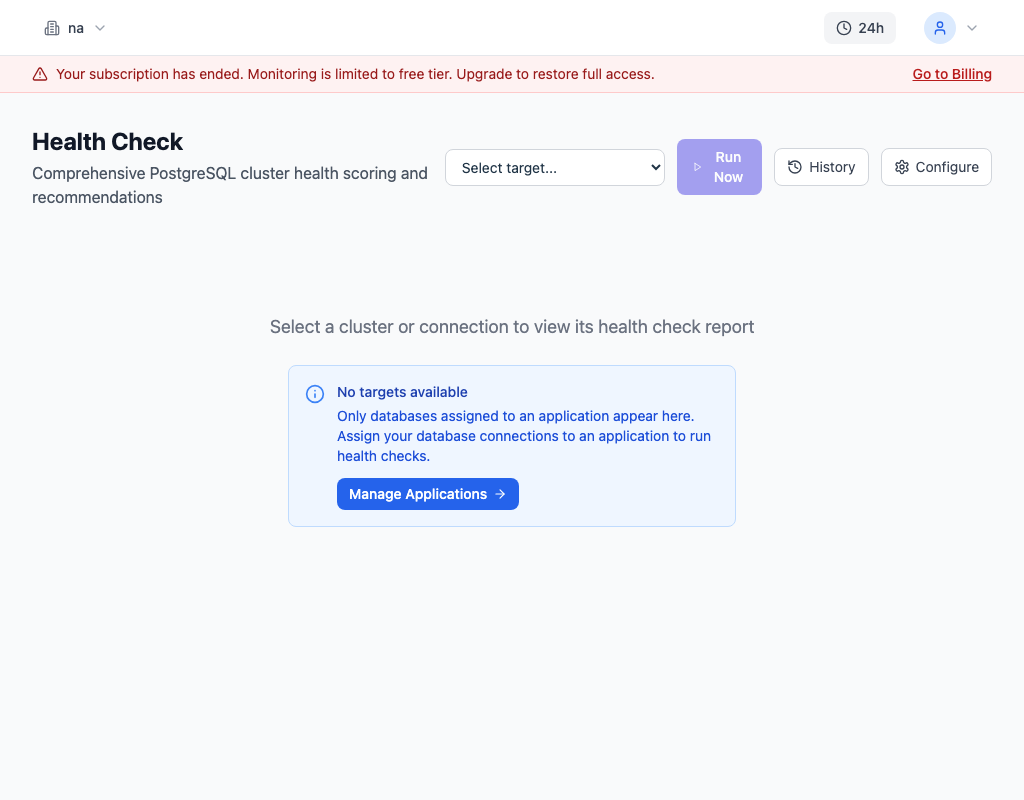
PMM's Advisors cover a solid set of security and configuration checks for PostgreSQL. MyDBA.dev runs 75+ health checks across 10 scored domains -- Vacuum, Indexes, Storage, Performance, Schema, Security, WAL & Backup, Connections, Replication, and Extensions. Each check that finds an issue includes a fix script: not just "this index is missing" but the exact CREATE INDEX statement to resolve it. The domain scoring (0-100 per domain, weighted overall score) lets you track improvement over time -- run the check, apply the fix, run it again, see the score change.
Index Advisor
PMM does not include an index recommendation engine. MyDBA.dev analyzes query patterns, sequential scan frequency, and table access statistics to recommend missing indexes. Each recommendation includes the CREATE INDEX statement, estimated impact, and the queries that would benefit. For large PostgreSQL deployments where missing indexes are a common source of slow queries, this fills a significant gap.
XID Wraparound Protection
Transaction ID (XID) wraparound is a PostgreSQL-specific risk that can force emergency autovacuum and, in the worst case, database shutdown. PMM exposes basic XID age metrics through its PostgreSQL dashboards, but it does not provide the specialized tooling that XID wraparound prevention requires.
MyDBA.dev provides dedicated XID wraparound monitoring with age tracking across all databases, blocker detection (identifying long-running transactions, prepared transactions, and replication slots that prevent XID advancement), trend analysis showing days until critical threshold, and recovery scripts for clearing blockers safely.
Extension Monitoring
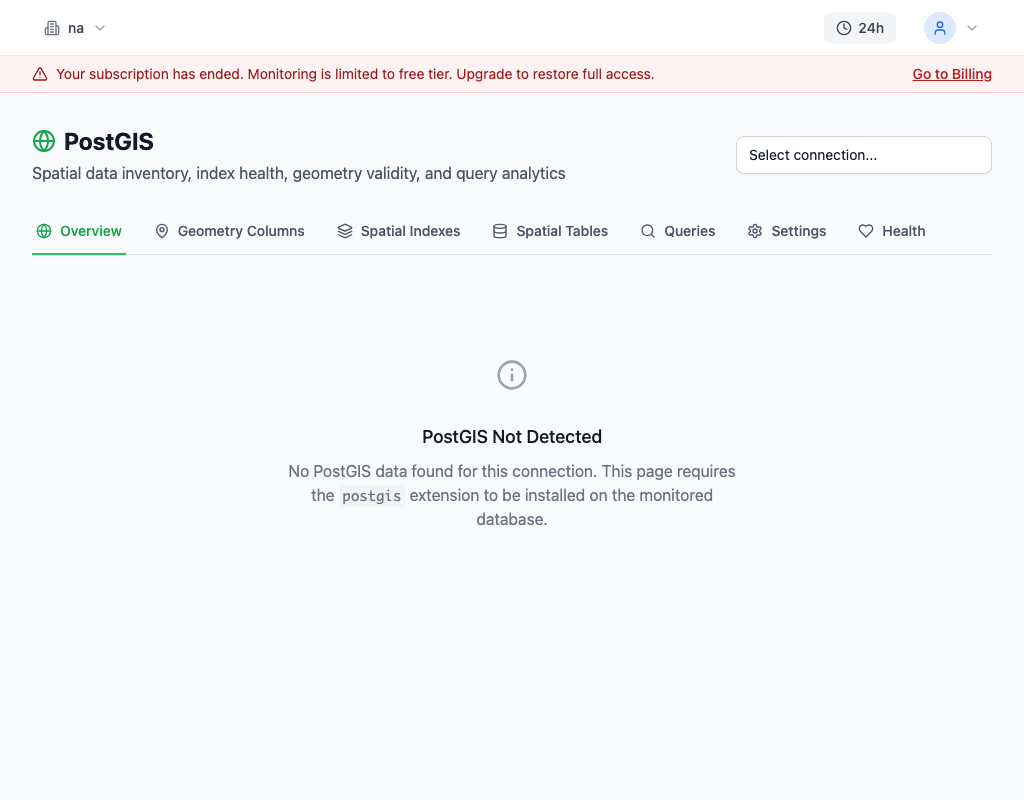
PostgreSQL's extension ecosystem -- TimescaleDB for time-series, pgvector for embeddings, PostGIS for spatial data -- is a major reason teams choose PostgreSQL over other databases. These extensions have their own performance characteristics, configuration requirements, and failure modes that generic database monitoring does not cover.
MyDBA.dev monitors TimescaleDB (chunk health, compression ratios, continuous aggregate freshness, job scheduling), pgvector (index selection, distance function performance, filtered search optimization, scaling characteristics), and PostGIS (spatial index efficiency, SRID consistency, geometry quality, query anti-patterns). PMM has no awareness of these extensions.
No Infrastructure to Manage
PMM requires you to deploy and maintain PMM Server (typically a Docker container or VM) plus PMM agents on every monitored host. You manage the server's storage, upgrades, availability, and resource allocation. For a team monitoring 3-5 PostgreSQL instances, that operational overhead is manageable. For smaller teams or those focused on application development rather than infrastructure, it is an unwanted burden.
MyDBA.dev is SaaS. You install a lightweight collector (a single Go binary) on each monitored host or use the managed collector fleet. There is no monitoring server to maintain, no Grafana to upgrade, no Prometheus storage to manage. The collector sends metrics to MyDBA.dev's hosted infrastructure.
Lock Chain Visualization
When queries block each other, understanding the dependency chain is critical for resolving incidents quickly. PMM provides standard lock metrics through pg_stat_activity and pg_locks views. MyDBA.dev renders interactive lock chain dependency graphs that show the full blocking tree -- which session holds the lock, which sessions are waiting, what queries are involved, and how long the chain has been active.
Schema Diff
Comparing schemas across PostgreSQL instances -- staging vs production, primary vs replica, before and after a migration -- is a common operational need. MyDBA.dev includes cross-instance schema comparison that highlights differences in tables, columns, indexes, constraints, and functions. PMM does not offer schema comparison.
Pricing Comparison
Percona PMM: Free and open source. You provide the infrastructure (Docker/VM for PMM Server, agents on each host). Operational cost is your team's time to deploy, maintain, and upgrade.
MyDBA.dev: Free covers one primary or standalone PostgreSQL instance, no replicas, all databases on that instance, all team members, all non-AI diagnostics and 30-day history. Collection frequency reduces after 7 days. Pro costs £50 per primary and £25 per replica per month (GBP), with every monitored instance billed, including the first. All databases, team members, non-AI diagnostics and 30-day history are included. On either plan, use an OpenRouter, OpenAI or Anthropic key with no product monthly AI quota; provider API usage is billed by the provider. New Pro subscriptions also include 20 platform-funded AI operations per organization per UTC calendar month.
The real cost comparison is PMM's infrastructure and operational overhead versus MyDBA.dev's subscription fee. For teams with existing ops capacity and a multi-database environment, PMM's zero licensing cost is compelling. For PostgreSQL-focused teams who want to avoid managing monitoring infrastructure, the subscription model trades money for time.
When to Choose PMM
PMM is the better choice when:
- You run MySQL, MongoDB, and PostgreSQL together and want unified monitoring
- You are already invested in Percona's ecosystem (Percona Server, xtrabackup, Percona Operators for Kubernetes)
- Your team has the ops capacity to self-host and maintain a monitoring stack
- You need backup and restore integration as part of your monitoring workflow
- Budget is the primary constraint and you have engineering time to spare
When to Choose MyDBA.dev
MyDBA.dev is the better choice when:
- Your environment is PostgreSQL-only or PostgreSQL-primary
- You want deep PostgreSQL-specific intelligence -- health checks with fix scripts, index recommendations, XID wraparound protection
- You use PostgreSQL extensions (TimescaleDB, pgvector, PostGIS) and need monitoring for them
- You want to avoid managing monitoring infrastructure -- no servers, no agents to coordinate, no Grafana to maintain
- You value remediation guidance alongside detection -- not just "there is a problem" but "here is the SQL to fix it"
- You need lock chain visualization and schema comparison tooling
The Honest Take
PMM is a solid, mature, genuinely free monitoring platform. Its multi-database support is a real advantage for polyglot environments, and the Grafana-based dashboards give you flexibility that purpose-built UIs sometimes lack. If you run MySQL alongside PostgreSQL and want one tool, PMM is hard to beat.
The trade-off is PostgreSQL depth. PMM was built on MySQL heritage and adapted to PostgreSQL. MyDBA.dev was built for PostgreSQL from the ground up. The difference shows in extension monitoring, index recommendations, XID wraparound tooling, lock chain visualization, and the 75+ health checks with scored domains and fix scripts. If PostgreSQL is your primary database and you want tooling that understands its specific failure modes and optimization opportunities, that specialization matters.